Andes Adventures
HIKING ADVENTURES
Patagonia Hiking Adventure

Torres del Paine
Torres del Paine National Park
Torres del Paine, Los Glaciares, Tierra del Fuego National Parks
All-Inclusive with ALL flights per person: From $5,795 (2013-14 prices)
17 days (no nights camping)
All-inclusive prices include international flights from Los Angeles or Miami and ALL flights in Patagonia, ground transportation in Chile and Argentina; hotels, shelters; and all meals.
Without a doubt the best value in a Patagonia hiking adventure. Before making your reservations with another company download and print our What's Included Checklist and compare!
See our FAQ and the detailed 17 day itinerary below for complete information. A 10 day trip option is also available.

Fitz Roy Group
Patagonia is a vast land of spectacular beauty. Southern Chile and Argentina share endless pampas, dense evergreen southern beech forests, sparkling turquoise lakes, abundant wildlife, immense glaciers and dramatic landscape with impressive pink, white and red granite towers.
This trek and hiking adventure combines trails in three National Parks — Torres del Paine National Park, Los Glaciares National Park, and Tierra del Fuego National Park.

Perito Moreno Glacier Patagonia
We begin in Torres del Paine National Park in Chile (UNESCO World Heritage site since1979), where we will hike to its renowned towers and horns. We drive across the border to Argentina and after a visit to the advancing Perito Moreno Glacier, we continue in Los Glaciares National Park in Argentina. There we will enjoy views of the famous granite massifs of Fitzroy (11,289’) and Cerro Torre (10,265’). We fly farther south to continue our hiking adventure in Tierra del Fuego National Park. Our adventure concludes with a visit to the cosmopolitan city of Buenos Aires.
Itinerary
All-Inclusive Cost Including Airfare |
||||
| Departure | Miami |
LAX |
||
Participants: |
16-24 |
12-15 |
16-24 |
12-15 |
| Dec. 19, 2014- Jan. 4, 2015 | $5,795 |
$5,995 |
$5,995 |
$6,195 |
| Jan. 4 - Jan. 20, 2015 | N/A |
N/A |
$5,595 |
$5,795 |
| Jan. 20 - Feb. 5, 2015 | N/A |
N/A |
$5,595 |
$5,795 |
Patagonia Flight Information All-Inclusive with ALL flights per person. |
||||
All-inclusive prices include international flights from Los Angeles or Miami and ALL flights in Patagonia, ground transportation in Chile and Argentina; hotels, shelters; and all meals.
(We also offer a shorter version of this adventure. See the Torres del Paine Hiking Adventure.)
Dec. 19,
2014- Jan. 4, 2015 Itinerary (PDF)
Jan. 4
- Jan. 20, 2015 Itinerary (PDF)
Jan.
20 - Feb. 5, 2015 Itinerary (PDF)
Day 1: Departure to Santiago
Day 2: Santiago/Punta Arenas
Early morning arrival in Santiago, where you will be met by your trip leader outside the customs area at the airport and continue together on your flight to Punta Arenas, located on the northern shore of the Strait of Magellan (S 53° 9.6', W 70° 54.5'). Overnight in Punta Arenas.
Overnight: Diego de Almagro Hotel
Meals: D.
Today's hike: None scheduled.
Day 3: Punta Arenas/Torres del Paine
After a nice overnight rest, we drive north through the Patagonian rolling plains and begin our Patagonia Hiking Adventure. Weather permitting, we plan a detour to visit a colony of Magellanic penguins in Otway Sound. We stop for lunch at the quaint town of Puerto Natales, situated on the shores of Seno Ultima Esperanza (Last Hope Sound). Afterwards we continue our drive to Torres del Paine National Park, on the way we will see large herds of sheep and baqueanos (cowboys). As we approach the park along Laguna Amarga, we will have our first views of the spectacular granite Towers of Paine. It is likely we will also enjoy sightings of herds of guanacos, condors, flocks of pink flamingos, a variety of foxes, geese, ñandus (wild ostriches) and other wildlife. After entering the park, we get settled at refugio Torres.
Overnight: Refugio Torres
Optional upgrade to Hosteria Torres
Meals: B, L, D.
Today's hike: Optional distances around the refugio in Torres del Paine.
Driving distance: About 240 miles plus additional 40 miles to the rookery.
Day 4: Torres del Paine - Hike to the towers
After reviewing the day's route with our guide, we hike up the Ascencio Valley. We cross the river and continue uphill along a lenga and cypress trail. As we pass by campamento Chileno and the foot of Mt. Almirante Nieto, the trail follows a southern beech forest, finally reaching a moraine that takes us to the cirque below the famous Towers of Paine; Torre Sur (9,350’), Torre Central (9,186’) and Torre Norte (8,530’). Downhill back to the refugio. Overnight at refugio Torres.
Overnight: Refugio Torres
Optional upgrade to Hosteria Torres
Meals: B, L, D.
Today's hike: 12.5 miles or about 6 to 8 hours, including the out-and-back hike to the towers. A shorter hike is optional.
Day 5: Torres del Paine
This morning we explore our surroundings and hike along the north shore of Lago Nordenskjold following the “W” circuit of the Park. Overnight at refugio Cuernos.
Overnight: Refugio Cuernos
Optional upgrade to Cabaña*
Meals: B, L, D.
Today's hike: 8 miles or about 5 hours.
*The December 19 Holiday departure will sleep at the brand new Frances site- one hour hiking beyond Cuernos.
Day 6: Torres del Paine - French Valley
We hike west of Lago Scottsberg and follow a trail along rolling foothills arriving at the Italian camp. You will have views of the enormous horns Cuernos del Paine (7,217’, 7,874’ and 8,530’) on the east and the glaciated Cerro Paine Grande (10,006’) on the west, as well as Lago Nordenskjold and Lago Pehoé. Overnight at Paine Grande Mountain Lodge on the shore of Pehoé Lake. Elevation: About 270'.
Overnight: Paine Grande Mountain Lodge
Meals: B, L, D.
Today's hike: 8 miles or about 4 hours. An optional out-and-back hike up the French valley, offers beautiful vistas of the Cuernos del Paine.
Day 7: Torres del Paine - Grey Lake & Glacier
We hike toward Lago Grey and Glacier Grey - a 4 mile wide glacier originating in the Continental Ice Cap. As we hike along Lago Grey, we will see turquoise-colored icebergs blown to the opposite side of the lake by the strong winds. We hike to Grey glacier and return late in the afternoon. The hiking group overnights at Paine Grande Mountain Lodge on the shore of Pehoé Lake.
Overnight: Paine Grande Mountain Lodge
Meals: B, L, D.
Today's hike: About 12 miles or 6 to 7 hours. A shorter hike is optional.
Day 8: Torres del Paine/El Calafate
We take a catamaran across Lago Pehoé and arrive at Refugio Pudeto where our vehicle is waiting for us. (Depending on wind conditions we may hike to the park headquarters). As we drive to the park entrance, we enjoy the best views of Lago Pehoé, Lago Nordenskjold and Lago Sarmiento as well as the Horns and Towers. We cross the Argentine border and arrive in the village of El Calafate on the shore of Lago Argentino.
Overnight: Tehuel Plaza
Meals: B, L, D.
Today's hike: None scheduled.
This is a long day of driving (about 5 1/2 hours), partly over dirt roads across the pampas. There is no other alternative way to travel, however there is always something to see along the way. Grazing sheep, wildlife and the unusual open range Patagonian steppes scenery.
Day 9: Parque los Glaciares - El Chaltén
We drive along Lago Argentino to the spectacular Perito Moreno Glacier – the world’s only glacier outside the polar region that is still advancing. Afterward we continue our drive north crossing Río (river) Santa Cruz and along Río La Leona to the shores of Lago Viedma till we reach the village of El Chaltén at 800 feet. As we approach El Chaltén we can see our first view of Mount Fitz Roy (11,171’) and Cerro Torre (10,177’). Overnight in El Chaltén.
Overnight: Hosteria Kalenshen.
Meals: B, L, D.
Today's hike: Short hike in Perito Moreno.
Day 10: Parque los Glaciares - Laguna de los Tres
We drive to north side of the park and hike through a beech and lenga forest. We have views of Piedras Blancas Glacier and Mount Fitz Roy. We cross the Poincenot camp and reach the basecamp of Río Blanco. You can continue on the optional hike to Laguna de los Tres, from where you will have outstanding views of Fitz Roy, the adjacent Poincenot neddle (9,849’), Rafael, Saint Exupery and other granite spires. Optional visit to Laguna Capri on your way down. Overnight in El Chaltén.
Overnight: Hosteria Kalenshen.
Meals: B, L, D.
Today's hike: About 8 miles or 6 hours, plus an optional out-and-back hike up to Laguna de los Tres.
Day 11: Parque los Glaciares - Laguna Torre
This morning we hike to Laguna Torre at 2,164’ at the base of Cerro Torre (you have the option to admire the view from the Fitz Roy valley). Cerro Torre (10,177’) is one of the most difficult mountains in the world to climb, because of its vertical walls topped by an overhanging mushrooms of ice. With some luck Patagonia’s unpredictable weather will cooperate and it will be clear enough to see Cerro Torre. Note that the height of the vertical east granite face of Cerro Torre is about 4,000 feet – nearly 1000 feet taller than Yosemite’s El Capitan. The hike continues through Laguna Madre e Hija and descends to El Chaltén. Overnight in our familiar lodge.
Overnight: Hosteria Kalenshen.
Meals: B, L, D.
Today's hike: About 9 miles or 6 hours. You also have the option to make your hike shorter or longer.
Day 12: Flight to Ushuaia
We drive to El Calafate and fly to Ushuaia the “Southernmost City in the World” on the island of Tierra del Fuego.
After lunch we board a boat or catamaran for a 3 hour cruise along the Beagle Channel. We cruise south to Isla de Los Pájaros (Birds' Island) and Isla de los Lobos (Sea Lion Island) where you can observe the Sea Lions and Imperial Cormorants. You will also see brown hooded Gulls, South American Terns, Black-browed Albatross, Giant Petrels, Great Skuas and other marine wildlife. After circling the Eclaireurs Light House, we return to Ushuaia sailing along the northern shore of the channel.
Overnight in Ushuaia.
Overnight: Hotel Tierra del Fuego.
Meals: B, L, D.
Today's hike: None scheduled.
Driving time: About 3 1/2 hours.
Flight: About an hour.
Day 13: Parque Nacional Tierra del Fuego
After breakfast we drive to Tierra del Fuego National Park west of Ushuaia. We start our hike at the Pampa Alta Trail. Our guide will lead us through lovely sub-Antarctic forests of beech, ñire, lenga, coihue and an abundance of moss and ferns. After reaching the top (about 1,000’) we enjoy a panoramic view of the Beagle Channel, Isla Redonda and Ensenada Bay. We descend and connect with Sendero de La Costa (Coastal Trail) and continue along the rocky shores of the bay finishing at Roca Lake. After lunch we visit Bahia Lapataia.
The park offers great opportunities for bird-watching. Some of the species that you will see are the Black-browed Albatross, Giant Petrels, Steamer Ducks, Magellanic Woodpecker, Thorn-tailed Rayadito, Chimango Caracaras, Black-Chested Buzzard Eagles and others. Overnight in Ushuaia.
Overnight: Hotel Tierra del Fuego.
Meals: B, L, D.
Today's hike: Today's hike: 8 miles with options for more or less.
Driving distance: 25 miles.
Day 14: Ushuaia/Buenos Aires
Morning flight to Buenos Aires, Argentina’s cosmopolitan capital. We arrive at Aeroparque Jorge Newberry Airport and transfer to our centrally located hotel, a few blocks from the city’s landmark, the Obelisco.
Overnight in Buenos Aires.
Overnight: Hotel NH Latino.
Meals: B, L, D.
Flight time: About 3 hours 20 minutes.
Day 15: Buenos Aires
We start our tour of Buenos Aires from the hotel. This tour shows you the city’s highlights, looking through its history and culture, the historic development, the immigration process, the architectural heritage, Peronismo era and other features of the Argentinean society. You’ll learn about cultural topics like tango music and soccer.
Starting from Plaza de Mayo we will enjoy a tour of the most remarkable highlights of this unique metropolis. Our itinerary will focus on the main places of interest of the southern and northern region of Buenos Aires: major plazas, colonial churches, old-time cafes, bohemian artist's quarter, colorfully painted metal houses, grand avenues, palatial mansions and spacious parks. We arrive in the neighborhood of San Telmo and complete our tour by bus, visiting the neighborhoods of La Boca, Puerto Madero, Palermo and Recoleta.
After lunch, time on your own for shopping and sightseeing in Buenos Aires.
Optional tango show and dinner. (See note below.)
Overnight: Hotel NH Latino.
Meals: B, L, D*.
Today's hike: None scheduled.
*A popular tango show and dinner is offered at a special discounted price, otherwise dinner is on your own and not included.
Day 16: Buenos Aires
Free day to enjoy Buenos Aires on your own.
Afternoon transfer to the Ezeiza International Airport for our evening flight home.
Meals: B.
Day 17: Arrival Home
The December 19 to January 4 Patagonia Hiking Adventures are held at the same time and overlaps much of the itinerary with the December 19 to January 4 Patagonia Running Adventures. It is possible for one person to participate on the Hiking Adventure and another on the Running Adventure and spend every night together.
It is possible to follow only part of the running itinerary, skipping the difficult running days in Torres del Paine. A 10 day trip option is also available.
We can accommodate your choice! Check with us for details!
Notes about Patagonia:
• Weather in this region is wildly unpredictable and changeable and itinerary is subject to change due to circumstances beyond our control including weather, road or trail conditions and flight schedules.
• On some days we will be driving on dirt roads.
• Due to the very short season in Patagonia, it is very difficult to get flight reservations on short notice. You must make your trip reservation in advance in order to assure space on the trip.
Please see Full Website for Additional Details
Inca Trail to Machu Picchu Trekking Adventure

Plaza de Armas, Cusco
Cusco, Sacred Valley, Inca Trail & Machu Picchu
11 Days (3 nights camping)
All-inclusive! From $2,850 including ground transportation in Perú, quality hotels, all meals, guided tours and first class trekking service.
Don't pay more for less! Before making your reservations, compare our adventures and prices with other well known companies. You will find that we offer unsurpassed value without compromising the quality of our trips in any way. Read what our guests say!
See our FAQ and the detailed itinerary below for complete information and departure dates.
Our adventure begins in Cusco, the archaeological capital of the Americas at an altitude of 11,150 feet. In Cusco you will see massive walls, cobblestone streets and remnants of the Inca Empire and the Spanish colonial period. After a tour of Cusco, and the Sacred Valley of the Incas, we are ready to start our trek on the ancient Inca trail that leads to the legendary lost city of Machu Picchu, an extraordinary adventure into the history of the grand Inca civilization.

Machu Picchu
Along the way, we explore the intriguing ruins of Inca fortresses, and enjoy expansive views from the high passes. One night we camp in a high meadow, above tree-line, and the next at airy Phuyupatamarca, "town in the clouds." Descending to the Sun Gate and Machu Picchu, the cloud forest trail becomes increasingly lush and varied. After two days exploring Machu Picchu — one of the world's most spectacular ruins — we take a train ride back to Cusco.
Itinerary
Land cost per person:
$2,850 (10-16 participants)
$3,050 (4-9 participants)
11 days (3 nights camping)
April 18 to April 28, 2014
May 16 to May 26, 2014
June 15 to June 25, 2014*
July 16 to July 26, 2014
August 22 to September 1, 2014
September 19 to September 29, 2014
October 17 to October 27, 2014
*Special departures:
June 15 to June 25, 2014 - Features the Inti Raymi Festival. From $3,050
Private departures on any date!
Note: You will need to depart a day earlier. The trip begins at the airport in Lima, on Day 1. We can make any additional reservations for you in Lima or Cusco. Detailed information will be included with the pre-departure information.
Day 1 Friday: Lima/Cusco
This morning you will be met at the Lima airport by an Andes Adventures representative, who will assist you with connecting flights to Cusco. Depart on a one-hour flight to Cusco, the ancient capital of the Inca Empire and the continent’s oldest continuously inhabited city. Our trip leader will meet you at the Cusco airport. Upon arrival in Cusco, we transfer to the hotel where a traditional welcome cup of coca leaf tea is served to help with the acclimatization to the 11,150 feet altitude. This afternoon we will have a guided sightseeing tour of the city, visiting the Cathedral, the Inca temple Qorikancha, and the Santo Domingo Monastery. You will receive a tourist ticket valid for the length of the trip enabling you to visit the many archaeological sites, temples and other places of interest. Welcome lunch and overnight in Cusco.
Overnight: Costa del Sol Ramada Cusco (Previously Picoaga Hotel).
Meals: L, D.
Today's hike: None scheduled.
Day 2 Saturday: Cusco
Morning visit to the archaeological sites surrounding Cusco, beginning with the fortress and temple of Sacsayhuaman, perched on a hillside overlooking Cusco at 12,136 feet. It is still a mystery how this fortress was constructed. Gigantic stones, some of them weighing 125 tons, were carved into huge trapezoidal blocks that fit together with extraordinary precision. The tour continues with visits to the semicircular shrine of Kenko, Puca Pucara and the Royal Baths of Tambomachay, a beautiful ceremonial bath, adorned with waterfalls, which continues to flow 500 years after being built. The rest of the day is for relaxing, shopping, and sightseeing in beautiful Cusco and its surroundings.
Overnight: Costa del Sol Ramada Cusco (Previously Picoaga Hotel).
Meals: B, L, D.
Today's hike: None scheduled.
Day 3 Sunday: Chinchero/Yucay
Our tour takes us on a scenic drive to Urubamba, the Sacred Valley of the Incas. We travel across a high plain with splendid views of the Cordillera Urubamba to the ancient Inca town of Chinchero at 12,350 feet. Chinchero is a picturesque community that combines both Inca and colonial architecture. It is market day and campesinos of the region still use the weekly market for trading food and other items, using the original method of exchange "trueque". We will observe a demonstration of the traditional weaving process and shop for local handicrafts. We visit the salt mines of Maras and continue with an acclimatization hike down a trail leading to the Urubamba River.

Overnight: Sonesta Posada del Inca Hotel in Yucay, Peru's Leading Boutique Hotel in 2011, 2012 and 2013 (World Travel Awards).
Meals: B, L, D.
Today's hike: 2.5 miles.
Day 4 Monday: Yucay
We hike on trails above the Inca agricultural terraces behind Yucay. Several options will be offered including hiking to the village of San Juan and possibly continuing to the glacier. You will enjoy beautiful views of the valley.
After lunch, we prepare for our Inca Trail adventure and spend the afternoon relaxing in Yucay and its surroundings.
Note: We no longer offer rafting on the Urubamba River in Cusco because pollution of the river has increased and the water quality is not suitable for rafting on any section of the river.
Overnight: Sonesta Posada del Inca Hotel in Yucay, Peru's Leading Boutique Hotel in 2011, 2012 and 2013 (World Travel Awards).
Meals: B, L, D.
Today's hike: Optional distances.
Day 5 Tuesday: Ollantaytambo/Llactapata
This morning we visit the village of Ollanta and Ollantaytambo, the best surviving example of an Inca town. Most of its buildings sit upon Inca walls and the street plan is still the original laid out by its Inca builders. Its stonework, narrow cobbled streets, family courtyards and water system are exactly as built in Inca times. You will be able to appreciate the Inca agricultural terraces that create small tiers of fertile land on very steep slopes.
After lunch we continue our drive to the trailhead at km 82 "Piscacucho," where we begin our trek. An easy hike along the Urubamba River brings us to our camp in the archaeological site of Llactapata "Town on Hillside" at 8,400 feet.
Upon arrival in camp we enjoy hot coca tea and a great view of the Urubamba mountain range.
Overnight: Camp at Llactapata.
Meals: B, L, D.
Today's hike: 4 miles – 3.5 hours.
Day 6 Wednesday: Llulluchapampa
The trail continues along the Cusichaca River and follows it upstream on a gradual climb leaving behind the Urubamba valley and a magnificent view of snow-capped Mount Veronica (18,865'), the highest peak in the Cordillera Urubamba. We reach the Quechua village of Wayllabamba at 9,680 feet, the last inhabited village on the Inca trail.
Entering spectacular Llulluchayoc gorge, the trail becomes steeper. We continue our uphill climb through a thick, mossy forest, before emerging into a large meadow - Llulluchapampa high above the tree line. We camp for the night at about 12,450 feet.
Overnight: Camp at Llulluchapampa.
Meals: B, L, D.
Today's hike: 6.5 miles 0r 7 hours
Day 7 Thursday: Phuyupatamarca
Today is our most challenging day as we reach Warmiwañusq'a pass "Pass of the Dead Woman" at 13,779 feet, the highest pass on the Inca Trail. If the weather is clear you will be delighted with the views of the Cusichaca Valley and the Pacaymayo "Sunrise" gorge ahead of us. A descent into the valley brings us to the Pacaymayo River at 11,880 feet.
We begin the climb toward the second pass, on the way we encounter the Runkurakay watchtower ruins at 12,464 feet and pass by a couple of small lakes, before reaching the Runkurakay pass at 13,000 feet.
From here you will have excellent views of the glaciated peaks of the Cordillera Vilcabamba. Most of the climb is behind us; the trail descends rocky slopes and reaches the strategic fortress of Sayacmarca "Dominant Town" at 12,234 feet.
The trail enters dense groves and you will find impressive evidence of Inca road construction, with its six feet wide and carefully constructed stone-paved trails. An amazing engineering accomplishment! We will negotiate a 20 meter Inca tunnel with carved steps and soon the trail becomes a magnificent stone staircase leading to Phuyupatamarca "Town in the Clouds" at 12,000 feet. We summit the third pass and have our first look into the deep gorge of the Urubamba River. Just below, we find our camp in Phuyupatamarca.
Overnight: Camp at Phuyupatamarca.
Meals: B, L, D.
Today's hike: 7.5 miles or 8-9 hours.
Day 8 Friday: Machu Picchu
The trail follows down a series of hundreds of steps, passing by ceremonial Inca baths where mountain water still flows through carved stone channels. As we descend into the cloud forest, we will be surrounded by an abundance of exotic varieties of plants, orchids and flowers until reaching the ruins of Wiñay Wayna "Forever Young." We hike down a dirt trail about three and a half miles to Intipunku, "Gateway of the Sun" at 8,860 feet. Suddenly, the full grandeur of the world's greatest ruins are revealed, the domed peak of Huayna Picchu and the lost City of the Incas, MACHU PICCHU at 7,900 feet. Our evening includes Machu Picchu Pueblo (previously known as Aguas Calientes).
Overnight: El Mapi Hotel Machu Picchu.
Meals: B, L, D.
Today's hike: 5.5 miles or 5 hours.
Day 9 Saturday: Machu Picchu
We spend the early part of the morning with our expert guide, for a tour of the mysterious city, its magnificent temples, terraced hillsides, archaeological curiosities, irrigation channels, fountains, elaborate stone work and chambers of unknown purpose. As we listen to the theories about the mysteries of Machu Picchu, we wonder how and why this city was built in such a remote place and what its purpose might have been. Fortunately this outstanding citadel was never discovered by the Spaniards and was spared from destruction.
Continue exploring the ruins of Machu Picchu, or relax in Aguas Calientes. You may also choose from several additional (unguided) activities such as a moderate hike to the Inca Bridge; or an optional climb to the 9,500 feet summit of Machu Picchu mountain or an optional climb to the airy summit of Huayna Picchu at 9,000 feet (the optional climb has to be arranged in advance).
Overnight: El Mapi Hotel Machu Picchu.
Meals: B, L, D.
Today's hike: Optional distances.
Day 10 Sunday: Cusco
This morning we board the train to Urubamba and continue by bus to visit the Andean village of Pisac. Our guide takes us through the village to visit its colorful market where extensive selections of colorful weavings, ceramics, sweaters and other handicrafts are sold at bargain prices.
The afternoon is free for last-minute shopping and enjoying Cusco. In the evening, we will have our farewell dinner in one of Cusco’s finest restaurants. Overnight in Cusco.
Overnight: Costa del Sol Ramada Cusco (Previously Picoaga Hotel).
Meals: B, L, D.
Today's hike: None scheduled.
Day 11 Monday: Cusco/Lima/Flight Home
After breakfast, transfer to the Cusco airport for the flight to Lima. Upon arrival we are met at the airport and we continue on a sightseeing guided city tour of colonial and modern Lima. Highlights include Lima's Cathedral, government palace in Plaza Mayor, San Francisco monastery, San Isidro, Miraflores and a scenic view of the coastline. We end the tour at the restaurant for lunch and from there we go to check-in at the hotel in Miraflores, where a day-room is available. Those departing tonight have a day-room and a transfer to the airport in the evening and depart on homeward-bound flights.
Day Room: Hotel San Agustín Exclusive in Miraflores.
Meals: B, L.
Today's hike: None scheduled.
(Or continue on Extension).
Please see Full Website for Additional Details
Inca Trail "Inti Raymi" Trekking Adventure to Machu Picchu

Inti Raymi Festival
Cusco, Inti Rayni Festival, Sacred Valley, Inca Trail & Machu Picchu
11 Days
(3 nights camping)
June 15 to June 25, 2014 (Group #1)
June 15 to June 25, 2014 (Group #2)
In 2014 the sale of Inca Trail permits opened on January 9 and almost all the permits needed for this adventure sold within a few hours. If you are interested in the 2015 departure of this adventure we recommend you reserve before January 1 so that we can secure the permits before they all sell out!
Don't miss the optional hiking extension around Mt. Ausangate! See the Itinerary below for details.
All-inclusive! From $3,050 including ground transportation in Perú, quality hotels, all meals, guided tours and first class trekking service.
Don't pay more for less! Before making your reservations, compare our adventures and prices with other well known companies. You will find that we offer unsurpassed value without compromising the quality of our trips in any way. Read what our guests say!
See our FAQ and the detailed itinerary below for complete information

The Inca is carried from Cusco
to Saccsayhuaman for the
Inti Raymi festival ceremony.
This adventure is a special, once a year, extension of the Inca Trail to Machu Picchu trek. We hike the Inca Trail the first five days. The Inti Raymi trekking adventure includes the Inca Festival of the Sun celebrated each year during the winter solstice; an authentic celebration to worship Apu Inti Taita, the Sun God. Processions, music and dancers in traditional clothing will offer their praises for the return of the Sun, the source of life.
The Inti Raymi trekking adventure is meticulously planned so you can visit Machu Picchu on June 21, the day of the Winter Solstice — the single most coveted day in the year to be in Machu Picchu — and return to Cusco in time for the annual Inti Raymi Festival on June 24.
Our adventure begins in Cusco, the archaeological capital of the Americas at an altitude of 11,150 feet. In Cusco you will see massive walls, cobblestone streets and remnants of the Inca Empire and the Spanish colonial period. After a tour of Cusco, and the Sacred Valley of the Incas, we are ready to start our trek on the ancient Inca trail that leads to the legendary lost city of Machu Picchu, an extraordinary adventure into the history of the grand Inca civilization.
Machu Picchu
Along the way, we explore the intriguing ruins of Inca fortresses, and enjoy expansive views from the high passes. One night we camp in a high meadow, above tree-line, and the next at airy Phuyupatamarca, "town in the clouds." Descending to the Sun Gate and Machu Picchu, the cloud forest trail becomes increasingly lush and varied. After two days exploring Machu Picchu — one of the world's most spectacular ruins — we take a train ride back to Cusco.
Our adventure concludes with the flight back to Lima and a guided city tour.
Itinerary
Land cost per person:
$3,050 (10-16 participants)
$3,250 (6-9 participants)
11 days (3 nights camping)
June 15 to June 25, 2014 (Group #1)
June 15 to June 25, 2014 (Group #2) Available
Don't miss the optional hiking extension around Mt. Ausangate! See the Itinerary below for details.
This Inca Trail trekking adventure includes the Inca Festival of the Sun, celebrated each year during the winter solstice; an authentic celebration to worship Apu Inti Taita, the Sun God. Processions, music and dancers in traditional clothing will offer their praises for the return of the Sun, the source of life.
Note: You will need to depart a day earlier. The trip begins at the airport in Lima, on Day 1. We can make any additional reservations for you in Lima or Cusco. Detailed information will be included with the pre-departure information.
Day 1 Sunday - June 15, 2014 Lima/Cusco
This morning you will be met at the Lima airport by an Andes Adventures representative, who will assist you with connecting flights to Cusco. Depart on a one-hour flight to Cusco, the ancient capital of the Inca Empire and the continent’s oldest continuously inhabited city. Our trip leader will meet you at the Cusco airport. Upon arrival, we transfer to the hotel where a traditional welcome cup of coca leaf tea is served to help with the acclimatization to the 11,150 feet altitude. This afternoon we will have a guided sightseeing tour of the city, visiting the Cathedral, the Inca temple Qorikancha, and the Santo Domingo Monastery. You will receive a tourist ticket valid for the length of the trip enabling you to visit the many archaeological sites, temples and other places of interest. Overnight in Cusco.
Overnight: Costa del Sol Ramada Cusco (Previously Picoaga Hotel).
Meals: L, D.
Today's hike: None scheduled.
Day 2 Monday - June 16, 2014 Cusco/Yucay
Morning visit to the archaeological sites surrounding Cusco, beginning with the fortress and temple of Sacsayhuaman, perched on a hillside overlooking Cusco at 12,136 feet. It is still a mystery how this fortress was constructed. Gigantic stones, some of them weighing 125 tons, were carved into huge trapezoidal blocks that fit together with extraordinary precision. The tour continues with visits to the semicircular shrine of Kenko, Puca Pucara and the Royal Baths of Tambomachay, a beautiful ceremonial bath, adorned with waterfalls, which continues to flow 500 years after being built.
Our tour continues on a scenic drive to the Andean village of Pisac in the Sacred Valley of the Incas. Our guide takes us through the village to visit its colorful market where extensive selections of colorful weavings, ceramics, sweaters and other handicrafts are sold at bargain prices.
Overnight: Sonesta Posada del Inca Hotel in Yucay, Peru's Leading Boutique Hotel in 2011, 2012 and 2013 (World Travel Awards).
Meals: B, L, D.
Today's hike: None scheduled.
Day 3 Tuesday - June 17, 2014 Ollantaytambo/Llactapata
This morning we visit the village of Ollanta and Ollantaytambo, the best surviving example of an Inca town. Most of its buildings sit upon Inca walls and the street plan is still the original laid out by its Inca builders. Its stonework, narrow cobbled streets, family courtyards and water system is exactly as it was built in Inca times. You will be able to appreciate the Inca agricultural terraces that create small tiers of fertile land on very steep slopes. After an early lunch we continue our drive to the trailhead at km 82 "Piscacucho," where we begin our trek above the Urubamba River. The trail reaches the archaeological site of Llactapata "Town on Hillside" at 8,400 feet.
Upon arrival in camp we enjoy hot coca tea and a great view of the Urubamba mountain range.
Overnight: Camp at Llactapata.
Meals: B, L, D.
Today's hike: 4 miles – 3.5 hours.
Day 4 Wednesday - June 18, 2014: Llulluchapampa
The trail continues along the Cusichaca River and follows it upstream on a gradual climb leaving behind the Urubamba valley and a magnificent view of snow-capped Mount Veronica (18,865'), the highest peak in the Cordillera Urubamba. We reach the Quechua village of Wayllabamba at 9,680 feet, the last inhabited village on the Inca trail.
Entering spectacular Llulluchayoc gorge, the trail becomes steeper. We continue our uphill climb through a thick, mossy forest, before emerging into a large meadow - Llulluchapampa high above the tree line. We camp for the night at about 12,450 feet.
Overnight: Camp at Llulluchapampa.
Meals: B, L, D.
Today's hike: 6.5 miles 0r 7 hours
Day 5 Thursday - June 19, 2014: Phuyupatamarca
Today is our most challenging day as we reach Warmiwañusq'a pass "Pass of the Dead Woman" at 13,779 feet, the highest pass on the Inca Trail. If the weather is clear you will be delighted with the views of the Cusichaca Valley and the Pacaymayo "Sunrise" gorge ahead of us. A descent into the valley brings us to the Pacaymayo River at 11,880 feet.
We begin the climb toward the second pass, on the way we encounter the Runkurakay watchtower ruins at 12,464 feet and pass by a couple of small lakes, before reaching the Runkurakay pass at 13,000 feet.
From here you will have excellent views of the glaciated peaks of the Cordillera Vilcabamba. Most of the climb is behind us; the trail descends rocky slopes and reaches the strategic fortress of Sayacmarca "Dominant Town" at 12,234 feet.
The trail enters dense groves and you will find impressive evidence of Inca road construction, with its six feet wide and carefully constructed stone-paved trails. An amazing engineering accomplishment! We will negotiate a 20 meter Inca tunnel with carved steps and soon the trail becomes a magnificent stone staircase leading to Phuyupatamarca "Town in the Clouds" at 12,000 feet. We summit the third pass and have our first look into the deep gorge of the Urubamba River. Just below, we find our camp in Phuyupatamarca.
Overnight: Camp at Phuyupatamarca.
Meals: B, L, D.
Today's hike: 7.5 miles or 8-9 hours.
Day 6 Friday - June 20, 2014: Machu Picchu
The trail follows down a series of hundreds of steps, passing by ceremonial Inca baths where mountain water still flows through carved stone channels. As we descend into the cloud forest, we will be surrounded by an abundance of exotic varieties of plants, orchids and flowers until reaching the ruins of Wiñay Wayna "Forever Young." We hike down a dirt trail about three and a half miles to Intipunku, "Gateway of the Sun" at 8,860 feet. Suddenly, the full grandeur of the world's greatest ruins are revealed, the domed peak of Huayna Picchu and the lost City of the Incas, MACHU PICCHU at 7,900 feet. Our evening includes Machu Picchu Pueblo (previously known as Aguas Calientes).
Overnight: El Mapi Hotel Machu Picchu.
Meals: B, L, D.
Today's hike: 5.5 miles or 5 hours.
Day 7 Saturday - June 21, 2014: Machu Picchu
We spend the early part of the morning with our expert guide, for a tour of the mysterious city, its magnificent temples, terraced hillsides, archaeological curiosities, irrigation channels, fountains, elaborate stone work and chambers of unknown purpose. As we listen to the theories about the mysteries of Machu Picchu, we wonder how and why this city was built in such a remote place and what its purpose might have been. Fortunately this outstanding citadel was never discovered by the Spaniards and was spared from destruction.
Continue exploring the ruins of Machu Picchu, or relax in Machu Picchu Pueblo - Aguas Calientes. You may also choose from several additional (unguided) activities such as a moderate hike to the Inca Bridge; or an optional climb to the 9,500 feet summit of Machu Picchu mountain or an optional climb to the airy summit of Huayna Picchu at 9,000 feet (the optional climb has to be arranged in advance).
Overnight: El Mapi Hotel Machu Picchu.
Meals: B, L, D.
Today's hike: Optional distances.
Day 8 Sunday - June 22, 2014: Chinchero/Yucay
This morning we board the train to Urubamba. Upon arrival we drive to the ancient Inca town of Chinchero at 12,350 feet. Chinchero is a picturesque community that combines both Inca and colonial architecture. We will visit a highland home and observe a demonstration of the traditional weaving process and shop for local handicrafts.
After lunch, we will spend the afternoon relaxing in Yucay and its surroundings.
Overnight: Sonesta Posada del Inca Hotel in Yucay, Peru's Leading Boutique Hotel in 2011, 2012 and 2013 (World Travel Awards).
Meals: B, L, D.
Today's hike: None scheduled.
Day 9 Monday - June 23, 2014: Yucay/Cusco
We hike on trails above the Inca agricultural terraces behind Yucay. Several options will be offered, including hiking to the village of San Juan. You will enjoy beautiful views of the valley.
After lunch we continue to Cusco. The afternoon is free for shopping and enjoying a very festive Cusco – in preparation for the festival..
Overnight: Costa del Sol Ramada Cusco (Previously Picoaga Hotel).
Meals: B, L, D.
Today's hike: None scheduled.
Day 10 Tuesday - June 24, 2014: Inti Raymi
Today we will be participating in the celebration of the Inti Raymi, the Inca Festival of the Sun, celebrated each year during the winter solstice. An authentic celebration that dates back from the Inca times to worship Apu Inti Tayta the Sun God. This is the most important Inca festival and Cusco will be filled with parades and processions.
First we go to the temple of the Sun "Qoricancha", where the Inca will begin the celebration and then follow to the Sacsayhuaman archaeological site, where we have excellent reserved seats to watch the ceremony and spectacular festival. Tonight we have our farewell dinner in one of Cusco's finest restaurants.
Overnight: Costa del Sol Ramada Cusco (Previously Picoaga Hotel).
Meals: B, L, D.
Today's hike: None scheduled.
Day 11 Wednesday - June 25, 2014: Cusco/Lima/Flight Home
After breakfast, transfer to the Cusco airport for the flight to Lima. Upon arrival we are met at the airport and we continue on a sightseeing guided city tour of colonial and modern Lima. Highlights include Lima's Cathedral, government palace in Plaza Mayor, San Francisco monastery, San Isidro, Miraflores and a scenic view of the coastline. We end the tour at the restaurant for lunch and from there we go to check-in at the hotel in Miraflores, where a day-room is available. Those departing tonight have a day-room and a transfer to the airport in the evening and depart on homeward-bound flights.
Day Room: Hotel San Agustín Exclusive in Miraflores.
Meals: B, L.
Today's hike: None scheduled.
For hikers continuing on to the Circuit of Mt. Ausangate Extension
Land cost (10-12 hikers): $825
Single Supplement: $60*
*Does not include single tent on the Ausangate circuit.
Day 11 Wednesday - June 25, 2014: Tinqui
This morning, we are picked up at the hotel for a 3 hour drive to the trailhead of the Ausangate circuit, in the highland village of Tinqui at 12,400 feet. We enjoy authentic Sunday markets as we drive by the Andean towns of Andahuaylillas, Urcos and Ccauri. We continue to Ocongate before reaching the village of Tinqui. Overnight in a rustic hostel.
Overnight: Rustic lodgings in Tinqui.
Meals: B, L, D.
Today's hike: None scheduled.
Day 12 Thursday - June 26, 2014: Upis
This morning we meet our Quechua arrieros with their pack animals. After loading our duffel bags on the horses, we start our uphill trek crossing the Mapocho River. The terrain turns into open arid grasslands known as puna. Scattered clumps of coarse grasses collectively called ichu characterize the treeless puna (this highland grass is used for roof thatch and fodder for grazing llamas and alpacas). We hike over rolling hills passing by stone walls and a few thatched houses. The trail continues up toward the north face of Mount Ausangate (20,905'), considered by these highlanders as the sacred Apu "Mountain Spirit." We will hike to Huahuayocrumi (14,765'), before descending into Upis at 14,400 feet. We camp by thermal pools.
Overnight: Upis Camp.
Meals: B, L, D.
Today's hike: 7.5 miles.
Day 13 Friday - June 27, 2014: Ausangatecocha
We start early this morning crossing the green Upismayo valley, filled with grazing llamas and alpacas. We begin our climb up to the Arapa pass at 15,585 feet and descend to Laguna Pucacocha at 15,080 feet. We have excellent views of the surrounding lakes and the glaciated west face of Mount Ausangate. We will continue up the Apacheta pass at 15,750 feet and a descent to our camp in Ausangatecocha.
Overnight: Camp at Lake Ausangatecocha.
Meals: B, L, D.
Today's hike: 8.5 miles.
Day 14 Saturday - June 28, 2014: Jampamayo Valley
We start our day going up Palomani Pass at 16,600 feet, our highest pass. From the southern face of Ausangate, we will have a fantastic view of Santa Catalina peak. In these high mountains, we might see the giant condor soaring high in the blue skies and a variety of highland birds like coots, Andean geese, cacaraca, hawks, puna ibis as well as the marmot like vizcacha. These remote mountain areas are also refuges for the protected vicuña. We descend towards Pampacancha (14,900'). We continue to Uchuy Finaya on the south side of Mount Ausangate and hike along the Jampamayo River valley and camp before reaching the village of Jampa. The views are overwhelming with the glaciers and the snow-capped mountains surrounding us; Colque-Cruz (19,554') and Tres Picos (19,990').
Overnight: Jampa Valley Camp.
Meals: B, L, D.
Today's hike: 7.4 miles.
Day 15 Sunday - June 29, 2014: Pacchanta
A short climb brings us to Jampa at 15,500 feet from where we continue our climb up to Campa Pass (16,400'), where we will be surrounded by spectacular views of glaciers and ice covered peaks. Looking down on our trail, we will see Lakes Comercocha and Caycocha. From the pass, we descend to Lake Minaparayoc. A moderate downhill takes us to the village of Pacchanta at 13,950 feet. We will enjoy a specially prepared traditional "pachamanca" dinner feast, prepared in an ancient Quechua method of cooking meat and vegetables underground with heated stones. We camp in Pacchanta for the night and enjoy the local hot springs.
Overnight: Pacchanta Camp.
Meals: B, L, D.
Today's hike: 10.6 miles.
Day 16 Monday - June 30, 2014: Tinqui/Cusco
Our last day on the circuit we continue to enjoy magnificent alpine scenery, with views of Mount Ausangate and the nearby snow-capped peaks of the Vilcanota range. We pass the small communities of Cullpacata, Yanama, Mojonpata and Quimsapuccio giving us our last chance to see remote Andean villagers. Herds of llamas, alpacas and their herders, in their colorful traditional clothing, work along the hillsides. Most speak no Spanish, only the ancient Quechua language. After returning to Tinqui we drive back to Cusco. Overnight in Cusco.
Overnight: Costa del Sol Ramada Cusco (Previously Picoaga Hotel).
Meals: B, L, D.
Today's hike: 6 miles.
Day 17 Tuesday - July 1, 2014: Cusco/Lima
After breakfast, transfer to the Cusco airport for the flight to Lima. Upon arrival we are met at the airport and we continue on a sightseeing guided city tour of colonial and modern Lima. Highlights include Lima's Cathedral, government palace in Plaza Mayor, San Francisco monastery, San Isidro, Miraflores and a scenic view of the coastline. We end the tour at the restaurant for lunch and from there we go to check-in at the hotel in Miraflores, where a day-room is available. Those departing tonight have a day-room and a transfer to the airport in the evening and depart on homeward-bound flights.
Day Room: Hotel San Agustín Exclusive in Miraflores.
Meals: B, L.
Today's hike: None scheduled.
(Or continue on Extension).
Please see Full Website for Additional Details
Andean Triangle Hiking Adventure & Marathons

Laguna Colorada
Eduardo Avaroa National Reserve
Northern Chile, Bolivia
and Southern Perú
Atacama Desert, Lake Titicaca, Salar de Uyuni
Reserve your 2014 Andean Triangle Adventure before March 7, 2014 and Save $200 per person!
13 Day Hiking Adventure
(No camping)
All inclusive cost, with airfare*:
Los Angeles: from $4195
Miami: from $4050
* Includes International & South America flights.
September 7 to September 19, 2014
Includes ground transportation in Chile, Bolivia and Perú, quality hotels, all meals, guided tours, and on-trail support. See our FAQ and the detailed itinerary below for complete information.
This adventure combines some of the world’s most impressive landscapes. We go through expansive deserts, impressive dunes, deep gorges, isolated mountain passes and other natural marvels of the high “altiplano” in the Andes:
- Atacama Desert – the driest desert in the world. (Northern Chile)
- Salar de Uyuni– the largest and highest salt flats in the world. (Southern Bolivia)
- Lake Titicaca – the highest navigable lake in the world. (Perú and Bolivia)
We begin in San Pedro de Atacama - the driest place on earth. As we approach San Pedro we will have views of the Cordillera de la Sal and its magnificent reddish clay and salt mountains. We will hike in the Valley of the moon, the Valley of Death and the Kari Gorge, a narrow canyon formed by water erosion and surrounded by enormous salt walls.
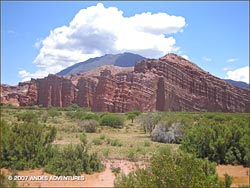
Rock Formations, Calchaquíes Valleys, Argentina
We continue to Bolivia, and enter the Eduardo Avaroa National Reserve crossing active geothermal fields, Laguna Colorada and other lakes. We reach the Salar de Uyuni, a 4,700-square-mile area of salt flats reputed to be the largest in the world. Some 40,000 years ago the area was part of Lake Minchin, a gigantic prehistoric lake. When the lake dried it left behind two major salt deserts. The largest one is the Salar de Uyuni. The mineral-rich lakes around the “salar” (salt flats) are breeding grounds for three species of South American flamingos: the Chilean, James’ and Andean.
We continue along the altiplano to the the town of Oruro and the next morning to La Paz. In La Paz we'll see steep cobblestone streets, and remnants of the Inca Empire and the Spanish colonial period. We will enjoy a walking tour of the colonial section, and the San Francisco and Murillo plazas (squares).
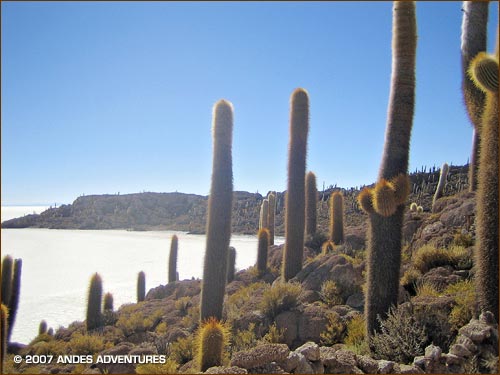
Incahuasi Island, Salar de Uyuni, Bolivia
We drive across the highlands to visit Tiwanacu (also known as Tiahuanaco), and from there continue to Lake Titicaca. At 12,500' (3810 m) Lake Titicaca the highest navigable lake in the world. We arrive in Copacabana on the Bolivian side of the lake. In Inca mythology, Manco Capac and Mama 0cllo, children of the Sun, emerged from the depths of Lake Titicaca to found the Inca Empire. With imposing snow-capped peaks along its far shores, the vast blue lake with its sparkling sapphire waters is one of the Andes' most enchanting scenes. (60% of the lake lies within Perú and 40% in Bolivia). The following day we take a boat to the Island of the Sun for a hike around the island.
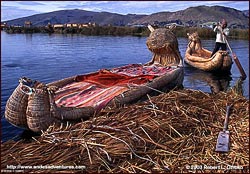
Reed Boats, Uros Islands
We return to Copacabana and continue to Puno on the Perú side of the lake. In the afternoon we will visit the "floating islands" of the Uros people – builders of the famous "totora" reed boats. The Uros and other lakeside residents depend extensively on the totora reed. It is used to make fishing boats and homes, as well as the amazing floating islands of reed.
We end our journey with a flight from Juliaca – Puno to Lima and connect with our flights home.
Itinerary
All inclusive cost, with airfare*:
Los Angeles: from $4195
Miami: from $4050
* Includes International & South America flights.
14 days (No camping)
September 6 to September 19, 2014
Daily hiking distances in the itinerary will be flexible and we will have vehicle support most of the time. It will usually be possible to hike shorter or longer distances than specified, or to opt out of a hike.
Day 1 – Sunday, September 7– Departure USA/Santiago
Day 2 – Monday, September 8– Santiago/San Pedro de Atacama
Arrival in Santiago and connect on our flight to Calama. Upon arrival in Calama, we continue on a 1 ½ hour bus drive to San Pedro de Atacama (8,000'/2,450 m).
The Atacama Desert is situated between the Andes Mountains and Pacific Ocean and stretches 600 miles (1,000 kilometers) from Peru's southern border into northern Chile. This region is extremely hyper-arid. It is an inhospitable, seemingly lifeless, sun drenched spot that is probably the driest place on Earth. Temperatures in the Atacama vary daily from 95°F down to 32°F.
The Atacama is 10 to 15 million years old and 50 times more arid than California's Death Valley. There are places where rain has never been recorded. This natural environment on Earth poses some of the same challenges for human explorers as would a seemingly lifeless planet. NASA scientists and engineers selected this landscape to test the technology that will be used in places like the Moon or Mars - the Atacama is "the closest place to Mars."
Overnight: La Casa de Don Tomas
Meals: L, D.
Today’s hike: None scheduled.
Today's flight: 2 hour flight from Santiago to Calama. Today's drive: 90 km (55 miles) from Calama to San Pedro de Atacama.
Day 3 – Tuesday, September 9– San Pedro de Atacama
Day on your own to relax, rest, recover and enjoy San Pedro de Atacama.
Overnight: La
Casa de Don Tomas
Meals: B, D.
Today’s hike: Optional hikes.
Day 4 – Wednesday, September 10– San Pedro de Atacama
Today we hike the best trails around San Pedro, including the Kari Canyon and the Valley of Death.
Overnight: La
Casa de Don Tomas
Meals: Breakfast & afternoon grill buffet lunch by the pool.
Today’s hike: 7.5 miles or longer option (12 km).
Today’s drive: Very short distances around San Pedro.
Day 5 – Thursday, September 11– Eduardo Avaroa National Reserve - Laguna Colorada - Desierto de Siloli
A one hour drive takes us to "Hito Cajon" at the Bolivian border. The Eduardo Avaroa National Reserve is in the southwestern section of Bolivia, bordering Chile and Argentina. This Puna region ranges in altitude from 11,482 feet (3,500 meters) and extends above 16,400 feet (5,000 meters).
We drive past Laguna Blanca and to Laguna Verde at the base of Licancabur volcano (19,455'/5,930 m)
Continue across the Bolivian altiplano to the hot springs in Laguna Salada and to the active geyser, “Sol de la Mañana”. From there to Laguna Colorada, a lake with a pinkish hue. This naturally occurring color results from algae and minerals in the lake, which is the main source of food for the thousands of pink flamingos. Three of the world’s six flamingo species – Chilean, James’ and Andean breed in this area.
The reserve has mammal species such as vicuñas, pumas, Andean foxes, vizcachas (Andean rabbit similar to marmot) and other. Andean geese, falcons, ducks and large, flightless birds called lesser rheas are some of the 80 species of birds living in Eduardo Avaroa Reserve
Today we do not have a scheduled hike due to the sudden climb to high elevation. We will however have opportunities for acclimatization hikes along the drive.
We continue our drive to our hotel in Ojo de Perdiz.
Overnight: Hotel
del Desierto.
Meals: B, L, D.
Today’s hike: No hike scheduled. Acclimatization hikes
to break the drive..
Today’s drive: About 7 hours with various stops in the altiplano.
Day 6 – Friday, September 12– San Pedro de Quemez
We continue north on the altiplano "high plain" where we will see llamas, wild herds of vicuñas, Andean geese and other wildlife.
Overnight: Hotel
de Piedra.
Meals: B, L, D.
Today’s hike: No hike scheduled. Acclimatization hikes
to break the drive.
Today’s drive: About 7 hours with various stops in the altiplano.
Day 7 – Saturday, September 13- Salt flats of Uyuni – Incahuasi Island –Oruro
This morning we enter the impressive Salar de Uyuni, the salar is 4,700-square-miles of salt flats - the largest in the world. Some 40,000 years ago the area was part of Lake Minchin a gigantic prehistoric lake. When the lake dried it left behind two major salt deserts, the largest one - the Salar de Uyuni. The salt is completely white and the depth is about 20 feet. We drive to the start of the hike, which will be on the salt flats and we finish on Incahuasi Island (12,010’/3,660 m) - a rocky outcrop in the middle of the vast white expanse of salt. Here you will see giant cacti covering the island creating one of the most surreal landscapes on earth. It is estimated that these cacti grows only about 1 centimeter per year. Some of the cacti reach up to 36 feet (11 meter) and are 1,200 years old.
We continue our drive to Oruro.
Overnight: Plaza Flores Hotel - Oruro
Meals: B, L, D.
Today’s hike: About 4 miles (6.5 km).
Today’s drive: About 6 hours.
Day 8 – Sunday, September 14– Oruro - La Paz
This morning we drive to La Paz (12,000’/3,660 m), we will have views of the impressive summit of Illimani (21,260'), the highest mountain in the Cordillera Real range on the southeastern side of the city.
La Paz is the administrative capital of Bolivia. We will have a tour of the city’s colonial and historical sections.
Overnight: Hotel Ritz Apart Hotel
Meals: B, L, D.
Today’s hike: Approximately 1 ½ hour hike.
Today’s drive: About 140 miles (229 km).
Day 9 – Monday, September 15– Tiahuanaco - Island of the Sun - Lake Titicaca
This morning we visit Tiwanacu (also known as Tiahuanaco), one of the oldest cultures in South America. It is believed to be the origin of the Pre-Inca Civilization. It was one of the most advanced cultures at that time. The main structures are the Kalasasaya temple with construction details similar to Machu Picchu's Gate of the Sun, the Akapana pyramid; and the semi-underground temple.
We travel in the highlands and continue along the eastern shore of the lake to the strait of Tiquina, which we cross by ferry and continue along the road overlooking the lake and arrive in Copacabana (12,634').
We take a private boat to the island section of Yumani and hike to our accommodations at the Ecolodge La Estancia.
Overnight: Ecolodge
La Estancia on the Island of the Sun in Lake Titicaca.
Meals: B, L, D.
Today’s hike: None scheduled.
Today’s drive: 45 miles/72 km (La Paz to Tiahuanaco) + 98 miles/158 km (Tiahuanaco to Copacabana).
Day 10 – Tuesday, September 16– Island of the Sun – Lake Titicaca
This morning we hike around the island. We follow the trail along the shore, passing by villages, agricultural fields, beaches until we reach Challapampa and from there we continue up to the Chinkana ruins where we turn south and continue on the mountain trail leading us around the island. After the hike we return by boat to Copacabana.
Overnight: Hotel
Rosario del Lago.
Meals: B, L, D.
Today’s hike: About 4 hours.
Today’s drive: None.
Today’s boat ride: 1 hour.
Day 11 – Wednesday, September 17– Copacabana - Puno
A short 15 minute drive to Kasani and across the border to Yunguyo - Perú. Continue overland to Puno (12,560').
Overnight: Hotel Sonesta Posada del Inca – Puno
Meals: B, L, D.
Today’s hike: None scheduled.
Today’s drive: 2.5 hours.
Day 12 – Thursday, September 18– Uros Islands - Sillustani /Lima/Flight Home
After breakfast, we leave from the hotel dock and travel by boat to the "floating islands" of the Uros people who build the famous "totora" reed boats. The Uros and other lakeside dwellers depend extensively on the totora reed. It is used to make fishing boats and homes as well as the famous floating islands of reed.
This afternoon we transfer to the airport at Juliaca, visiting the ruins of Sillustani en route. Sillustani is in a beautiful setting on a barren, windswept peninsula about 15 miles from Puno. Here we'll view chullpas (pre-Columbian funeral towers) that date from the time of the Inca occupation of this region, around the 15th century. These towers were built by and for people of the Aymara-speaking Colla tribe. Sillustani's stone architecture is complex and different in many ways from Inca stonework.
Arrival at the Lima airport and connect to your flight home. Meals: B, L.
Today’s hike: None scheduled.
Today’s boat ride: Boat tour to the Uros islands (Peru).
Day 13 – Friday, September 19– Arrival home
Please see Full Website for Additional Details
Galapagos Hiking Adventure

Kicker Rock
San Cristobal Island
Galápagos National Park and Cajas National Park
Land cost per person: From $3,350
10 Day Hiking Adventure
(No camping)
April 10 to April 19, 2015
$500 Internal flights - Guayaquil-San Cristobal/Baltra-Guayaquil (Flight cost subject to change)
$150 Chartered boat (San Cristobal-Floreana-Isabela)
$100 Galapagos National Park entrance fee
$10 Galapagos Tax
Land cost from $3,350 including ground transportation in Ecuador, quality hotels, most meals, guided tours. See our FAQ and the detailed itinerarys below for complete information.

Blue-footed Booby
Galápagos National Park is located in the Pacific Ocean 600 miles west of mainland Ecuador. About 20 million years ago, deep sea volcanoes caused multiple eruptions that created the Galapagos archipelago. The Galapagos Islands consist of a cluster of over 60 islands and islets.
Charles Darwin explored the Galapagos in 1835 and was amazed by the number of unique species in the different islands that led him in 1859 to the publication of the “Origin of the Species” which changed the course of modern evolutionary thought.
This exciting land-based program offers a great value in the archipelago. Our unique adventure is an ideal way to explore these remarkable islands and visit areas not visited by the traditional boat tours — and at the end of every night you will sleep in a comfortable hotel.
We will hike the highlands of San Cristobal Island, in the Sierra Negra Volcano on Isabela Island and the Santa Cruz highlands where we will see giant tortoises in their own habitat.

Giant Tortise
With our English-speaking naturalist guides, we will learn about the natural history of these islands and the fascinating species such as tortoises, marine and land iguanas and the diving blue-footed boobies. There are no predators and the wildlife has no fear of humans, which makes the wildlife viewing amazing.
We finish our adventure with a visit of Cuenca, the Llaviuco Valley, Cajas National Park, the Manglares-Churute reserve and Guayaquil. We will have two additional hikes on the mainland.
2015 Itinerary
April 10 to April 19, 2015
Day 1 Friday — April 10, 2015: Arrival in Guayaquil
We arrive at Guayaquil airport in Ecuador, where you will be met by an Andes Adventures representative who will assist you with your luggage and your transfer to the hotel.
Overnight: Hilton Colon Guayaquil Hotel
Meals: On your own on arrival day. Program starts on Day 2.
Day 2 Saturday — April 11, 2015: Guayaquil – San Cristobal Island – El Junco Lake
After breakfast we return to the airport for our non-stop one and half hours flight to San Cristobal Island. Upon arrival we pass through an inspection where park officials ensure that no foreign plants or animals are introduced to the islands and this is where you need to pay the Galápagos National Park entrance fee of $100.
After lunch we drive to El Junco Lake in the highlands of San Cristobal; this crater has been filled with rain water for millions of years and is part of the only permanent fresh water source in the archipelago. We will hike around the lake and take some dirt roads across fields of miconia plants, ferns and small bushes that constitute this highland environment. We continue down to our hotel.
Overnight: Hotel Blue Marlin or Hotel Katarma - San Cristobal
Meals: B, L, D.
Today's hike: About 6 miles or less.
Day 3 Sunday — April 12, 2015: Tijeretas Hill to Loberia – Snorkel Leon Dormido (Kicker Rock)
We hike to Cerro Tijeretas through a path that take us to the place where Darwin disembarked from the HMS Beagle and set foot on the Galápagos for the first time in 1835. Along the path, Darwin’s findings and theories (from his short five-week stay on the islands) are shared as well as the history and significance of the Galápagos. We ascend to the top of Cerro de las Tijeretas (Frigate Bird Hill) where breathtaking sea views unfold, also a perfect vantage point to marvel at the antics of frigate birds, known as the "pirates of the sea," owing to their habit of stealing food from unassuming boobies. We continue hiking on the trail to Carola Beach and then across town to La Loberia Beach, from where we will hike back to our hotel.
After our morning hike we board a fully equipped, large comfortable boat for the one-hour ride to Leon Dormido (sleeping lion), so named because of its shape, but more commonly known as Kicker Rock. The remains of a lava cone eroded by the sea have formed two vertical rocks rising 500 feet from the ocean, which in turn form a small channel that is perfect for snorkeling. The colorful display of tropical fish contrasts against a backdrop of black volcanic rock. Razor surgeonfish, Cortez rainbow wrasse, and orange-bellied triggerfish are just a few you may see, as well as a gentle sea Turtle floating by.
A fresh lunch is served on deck.
We return to town with time to stroll the quiet streets.
Overnight: Hotel Blue Marlin or Hotel Katarma - San Cristobal
Meals: B, L, D.
Today's hike: About 1 ½ hours. You can hike additionally on your own at the end of the day.
Activity: Snorkeling
Day 4 Monday — April 13, 2015: Floreana Island - Isabela Island
The Island of Floreana rests south-west of Santa Cristobal (approximately 2.5 hour boat ride, depending on sea conditions).
We arrive at Puerto Velasco Ibarra on the west side of the Island. Floreana was one of the first Islands to become inhabited on a permanent basis, and was considered a key resupply point by whaling ships and other boats due to its supposedly inexhaustible supply of tortoises.
Upon arrival in Floreana we will take a 30-minute drive up to the highlands through the agricultural fields and a stunning landscape dominated by forests of the endemic miconia trees, and palo santo.
We drive around Cerro Pajas (640 m), the largest volcanic hill in Floreana until we reach el Asilo de la Paz -- where the most interesting human history of Galapagos took place. Your guide will describe the adventure, romance and mystery of the area as you walk the trails, encounter Galapagos giant tortoises, and visit beautiful springs and incredible lava formations. The hike takes approximately one hour.
After lunch we continue by boat to Isabela Island (approximately one hour) and arrive in the quaint town of Puerto Villamil. Isabela the least-visited and the archipelago's largest island, is formed by the joining of five young volcanoes.
Overnight: La Casa de Marita – Isabela
Meals: B, L, D.
Boat: 2.5 hour boat from Cristobal to Floreana & 1 hour from Floreana to Isabela. Times can vary depending on water conditions.
Today's hike: One hour hike.
Day 5 Tuesday — April 14, 2015: Tintoreras – Tortoise Breeding Center – Wetlands
Our panga (small boat) awaits us to take us on a journey to the tiny island of Tintoreras, a unique volcanic formation and our hiking – snorkeling destination for the day.
The western side of the island is home to a primitive species of lichen which flourishes in the moisture carried by the prevailing winds. It is inhabited by young marine iguanas, the world's only sea-going lizard, small colonies of sea lions. White-tipped reef sharks can occasionally be spotted taking a well-earned rest among the nooks and crannies of the volcanic formation comprising this beautiful island. Boobies put on quite a show in the quiet lagoon and, we may even catch a glimpse of the Galápagos penguin.
We will have a relaxed day and visit the Tortoise Breeding Center, where the National Park has been making an immense effort to protect tortoises in their first years of life from the threats of introduced species. We will be able to see the different shells from each race (sub-species) and learn more about the natural history and importance of the Galápagos giant tortoise.
A boardwalk leads us over the marshlands or humedales—brackish lagoons that provide a habitat for four mangrove species and numerous other migratory birds flamingos, darwin finches, yellow warblers, galapagos flycatchers, stilts, pintail ducks, common gallinule and other shore birds that come to feed in the lagoons. Marine iguanas are seen in the lava rocks and sand banks that form these swamps.
The wooden walkways lead to a tortoise breeding center with interesting interpretive displays. The center has been responsible for the breeding and release to the wild of over 2,000 giant tortoises in the past few years alone. There are different distinct varieties from each of the volcanoes in the island. The difference can be seen in their shells.
Volcanoes on Isabela Island include Sierra Negra Volcano (3,688'), Alcedo Volcano (3,707'), Wolf Volcano (5,600'), Cerro Azul Volcano (5,541'), Darwin Volcano (4,350') and Ecuador Volcano (2,590')
From the center, a walk along the beach takes you through town and back to the hotel, where you can take a swim or stop in town to get a taste of local life.
Isabela is a great snorkeling site where sea turtles, shark and rays are seen.
Overnight: La Casa de Marita – Isabela
Meals: B, L, D.
Today's hike: We will hike about 2 hours on easy, gravel, and wooden trails, flat terrain.
Activity: Snorkeling.
Day 6 Wednesday — April 15, 2015: Sierra Negra Volcano – Campo Duro
After a one-hour drive from Puerto Villamil to Isabela’s Highlands, you gain an entirely new perspective on the Galápagos experience. At the starting point of today’s hike you immediately notice the difference in vegetation and weather—fostered by the southeast trade winds that bring significant humidity to the southern side of the island. The lowland landscape of prickly pear and the endemic candelabra cactus that dominate the coastal areas give way to more lush and diverse flora including bromeliads and epiphytes.
Your path leads to the rim of the Sierra Negra Volcano. The Sierra Negra Volcano stands at 3,688 feet and last erupted in 2005, depositing a new and dramatic layer of lava. This volcano’s caldera is the world’s second largest, with a diameter measuring approximately 6½ miles.
As you circle the caldera, you spot a variety of birds including finches and flycatchers as well as the Galápagos hawk. Lava lizards scuttle underfoot. From the caldera’s rim you continue to Chico Volcano to see fumaroles (gas and steam vents in the earth’s crust) and unusual lava formations, a striking visual record of the islands’ geological history. We enjoy spectacular views of volcanoes and nearby islands.
Overnight: La Casa de Marita – Isabela
Meals: B, L, D.
Today's hike: We will hike about 11 miles.
Day 7 Thursday — April 16, 2015: Galapagos – Guayaquil – Paute Valley
Today will be a travel day. This morning we will take a 2-hour boat ride (duration depends on water conditions) to Baltra Island. Upon arrival in Baltra we will be picked up by a bus and will take a 10-minute bus ride to the airport in time to check our bags and take our flight back to Guayaquil. From the Guayaquil airport we will fly to the Cuenca airport and drive (approximately 1 hour) to Paute.
Hosteria Uzhupud is a colonial-style hacienda, a hub of quietude surrounded by well-kept gardens where guests can relax and reflect. Each cozy room is equipped with a private bath, cable TV, Wi-Fi and a telephone for keeping in touch with your loved ones. Uzhupud and its surroundings are steeped in history and tradition. Enjoy the subtropical climate and ideal location in the Andes—only half an hour from Cuenca. A quaint little church, an open-air swimming pool, and an area for games, make Uzhupud all the more inviting.Overnight: Hacienda Uzhupud in Paute
Meals: B, L, D.
Boat: 2 hour boat from Isabela to Baltra (can be to 2.5 hours depending on water conditions)
Flights: Baltra to Guayaquil 1.5 hour flight & Guayaquil to Cuenca 40 minutes flight.
Drive from Cuenca airport to Paute: About 40 minutes to one hour depending on traffic conditions
Today's hike: None-scheduled.
Day 8 Friday — April 17, 2015: Tolapaloma – Quebrada El Salado – Cuenca
A short drive from our hotel will put us at the beginning of our hiking adventure. Along the road we will enjoy breathtaking views down into the valleys and of the dramatic canyons formed by ravines that descend from the forest.
The hike will take us through a beautiful elfin forest characteristic of the valleys that are formed by the Andes Cordillera. Here we will find orchids, epiphytes, polilepys trees, and a wide variety of hummingbirds. The hike is an easy 7 mile descent from 10500 feet to 8600 feet and we finish our hike at the volcanic hot spring pools.
After lunch we take a short drive to visit the colonial part of Cuenca city. Santa Ana de los Ríos de Cuenca is set in a valley surrounded by the Andean mountains in the south of Ecuador. This colonial town, now the country's third largest city, was founded in 1557. Cuenca's architecture, much of which dates from the 18th century, was 'modernized' in the economic prosperity of the 19th century as the city became a major exporter of quinine, straw hats and other products. The historic center of Santa Ana de los Ríos de Cuenca was declared a UNESCO World heritage site in 1990. The city has a distinctive Spanish style with prominent French influences.
Cuenca is a colonial jewel, reminiscent of Europe with its narrow cobblestone streets, its quiet demeanor, and its charmingly old-fashioned ambiance. The many sights of interest here include the city’s main cathedral, numerous other churches like Santo Domingo, San Sebastian and San Blas among others as well as Inca ruins.
The Incas occupied the area now known as Cuenca for less than 100 years. At that time the area was inhabited by the Cañari people.
We return to Uzhupud to relax in the gardens and pool.
Overnight: Hacienda Uzhupud in Paute
Meals: B, L, D.
Today's hike: About 7 miles.
Day 9 Saturday — April 18, 2015: Cloud Forest Hiking – Manglares Churute - Guayaquil
Our hike starts at the entrance of Llaviuco Valley. We hike along a secondary road passing several cattle farms, before reaching Cajas National Park where we find the beautiful Llaviuco Lake. From here we follow a small path into the cloud forest hiking along a small river.
Cajas National Park covers about 71,000 acres and contains about 230 glacial lakes. The ‘U’ shape of Lake Llaviuco, the lowest point in the park, is due to prehistoric glacial activity.
In the park you will find rolling paramo grasses, wild quinoa, rosemary, an abundance of birds and mammals such as the Andean Fox, White Tailed Deer, Spectacled Bear and other wildlife that are found in these lofty Andean elevations. Trout is also found in several of the moorland’s lakes.
Journeying along a small path into the lush cloud forest and past glinting streams, we circle Lake Llaviuco, an excellent spot for nature-watching.
Next, just 25 miles south of Guayaquil is an ecological gem just waiting to be explored: the Manglares–Churute Mangrove Reserve. The reserve spans around 123,550 acres and includes two amazingly biodiverse ecosystems --a tropical dry forest and what is considered to be the largest mangrove reserve in Ecuador.
Mangrove trees grow in ecosystems bridging the gap between land and sea along tropical coastal zones, acting as a kind of filtration system removing sediments before reaching open water and protecting coral reefs, controlling pollution and providing food and habitats for fish, reptiles, amphibians, mammals and birds. The muddy estuaries of the River Guayas are home to the mangroves covering around two thirds of the Reserve and where shrimp farming has been outlawed due to its impact on the area’s natural ecosystems.
Manglares-Churute is also characterized by natural salt flats which serve as popular feeding spots for a whole host of eye-catching shorebirds such as roseate spoonbills, ospreys, egrets, and laughing gulls. Vegetation rich in balsa and oak trees, punctuated with orchids and bromeliads, surrounds the mangroves and if we are lucky enough on our boat journey through this spectacular habitat, we may even spot the horned screamer bird, among other creatures equally delightful and intriguing.
We arrive in Guayaquil, the capital of the province of Guayas and the main port and economical capital of the country. Tonight we will have our farewell dinner.
Overnight: Hilton Colon Guayaquil Hotel
Meals: B, L, D.
Today's hike: About 7 miles.
Day 10 Sunday — April 19, 2015: Guayaquil/Flight home
Transfer to the airport and depart on homeward-bound flights.